A visitor should not have to decode your business before deciding whether to contact you. For Malaysian companies serving customers with different language preferences, a bilingual website can make the offer easier to understand. The work goes beyond translating the menu.
Translate the decision, not just the words
Start with the pages that help someone decide: services, product details, pricing explanations, delivery information and contact. Keep the meaning consistent while allowing each language to sound natural. A literal translation can be technically correct and still feel uncomfortable to read.
For example, a friendly BM button such as “Jom bincang” may suit a studio, while a formal procurement service may need a more direct “Minta sebut harga”. Choose the voice that fits the customer and the action.
Keep the language switch easy to find
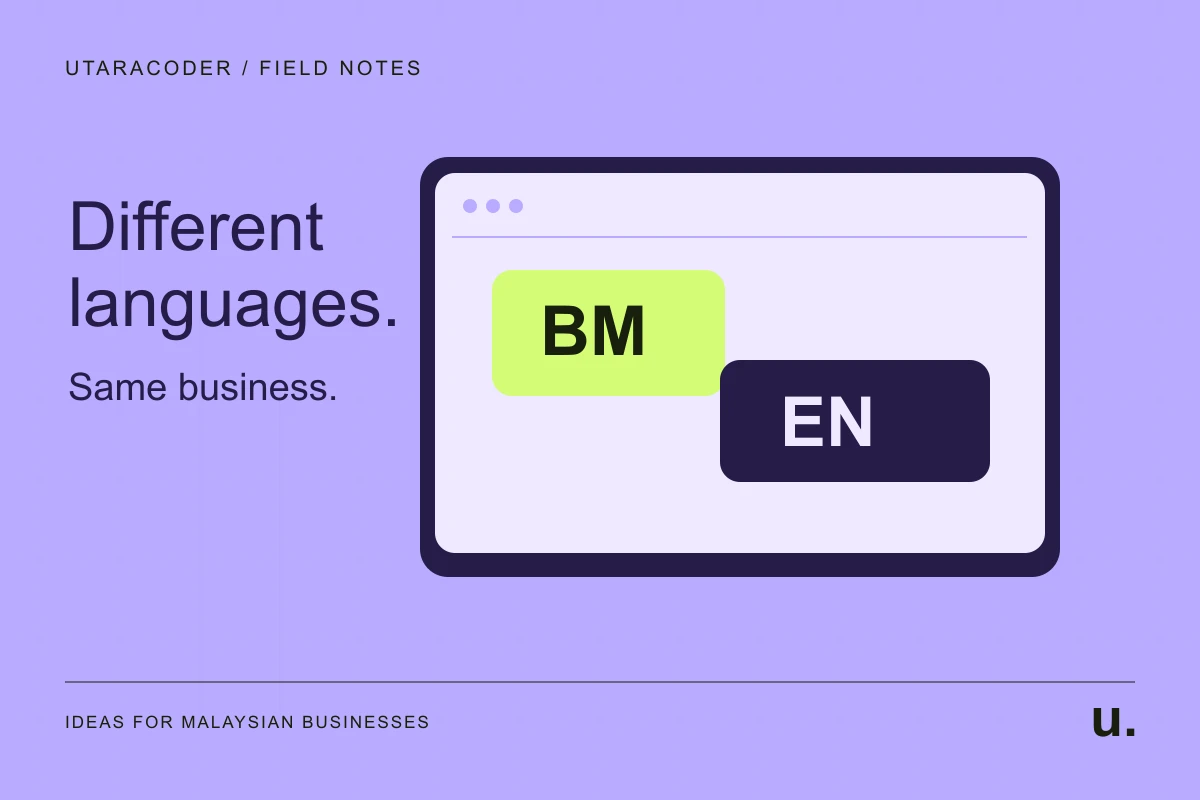
Use clear BM and EN labels and keep the visitor on the equivalent page when they switch. Review form labels, error messages and confirmation screens as carefully as headlines. Test the longer version of every button on a small phone.
Decide who owns updates. If an offer changes in English, its BM version should be reviewed in the same publishing task. A bilingual site needs a simple maintenance routine to stay consistent.
Give search engines a clear version to visit
Google recommends distinct URLs for different language versions and links that let visitors choose a language. Its documentation also explains how hreflang annotations identify equivalent language pages. This helps discovery; it does not guarantee rankings.
Ask your developer how translated pages are linked, how their canonical URLs are handled and whether their main content can be read without clicking a language button first. The official Google guide is linked below.